Get $497 in Bonuses When You Order Product Driven
THE PRODUCT DRIVEN NEWSLETTER
When Product Strategy Turns Into Lord of the Flies
August 28, 2025
You’ve got smart people. A clear goal. A roadmap full of initiatives.
So why does everything still feel... off?
One team’s building the future.
Another’s fixing the past.
A third is off-road entirely, convinced their thing is the most important.
You get on a call and realize:
Everyone heard the same plan—
But no one walked away with the same understanding.
Welcome to the post-strategy chaos stage.
The Myth of the “Clear Plan”
Most companies think their problem is strategy.
It’s not.
Everyone has some strategy.
The problem is no one knows how to execute it together once things start moving.
At zero to one, this isn’t a problem. You’re in the room. You feel the signals.
But once you’ve got more than a few teams, those instincts break.
You assume your message made it downstream.
It didn’t.
You assume your teams are aligned.
They’re not.
What you’ve got instead is something Randy Silver described perfectly in our conversation:
“Autonomous teams doing whatever they want—without guardrails, communication, or shared goals.”
That’s not autonomy.
That’s anarchy.
And it happens all the time.
Where It All Starts to Break
You can usually trace the breakdown to one of three dysfunctions:
1. The Bottleneck Org
The founder or exec team is still making every decision.
No one else can move without permission. Execution slows. Teams disengage. And any innovation has to fight its way up the food chain before it ever gets built.
2. The Lord of the Flies Org
You gave teams autonomy—but forgot to give them alignment.
Now every team is optimizing for what’s best for them, not for the product. Priorities compete. Strategies fragment. And no one sees the whole picture.
3. The Vacuum Org
No top-down clarity. No bottom-up ownership.
Just aimless execution. Work gets done, but no one’s sure why—or if it matters.
If you’re nodding your head, you’re not alone.
You’re not broken.
You’re scaling.
But unless you fix it, your best people will burn out building the wrong thing faster.
What Strategy Actually Needs to Work
Here’s the shift that hit me in this conversation with Randy:
Vision is not enough.
You also need:
A clear diagnosis (Where are we, really?)
A guiding policy (Where are we trying to go?)
Coherent action (How will we get there, together?)
Most teams get maybe one of those. Two, if they’re lucky.
But without all three? You can’t prioritize. You can’t scale decision-making.
And you definitely can’t trust your teams to think like owners.
Autonomy Requires Structure
If you're aiming for true team autonomy, here's what it actually requires:
Clarity of purpose
Transparent communication
Mutual accountability
Aligned incentives
Autonomy isn't freedom to go rogue.
It's freedom within a shared strategy.
You want your teams to build like entrepreneurs?
Give them the constraints a real entrepreneur has:
A mission. A customer. A clear goal. And responsibility for the outcome.
That’s how you scale ownership without losing your grip on direction.
How to Know If You’re Already There
Ask yourself:
Are teams working toward the same definition of success, or just closing tickets?
Do roadmaps overlap and contradict across teams?
Is anyone responsible for integrating the bigger picture?
When you say the strategy out loud, do you actually believe your teams could explain it the same way?
If not, you’re probably already living in the jungle.
Everyone’s got a spear. No one’s got a map.
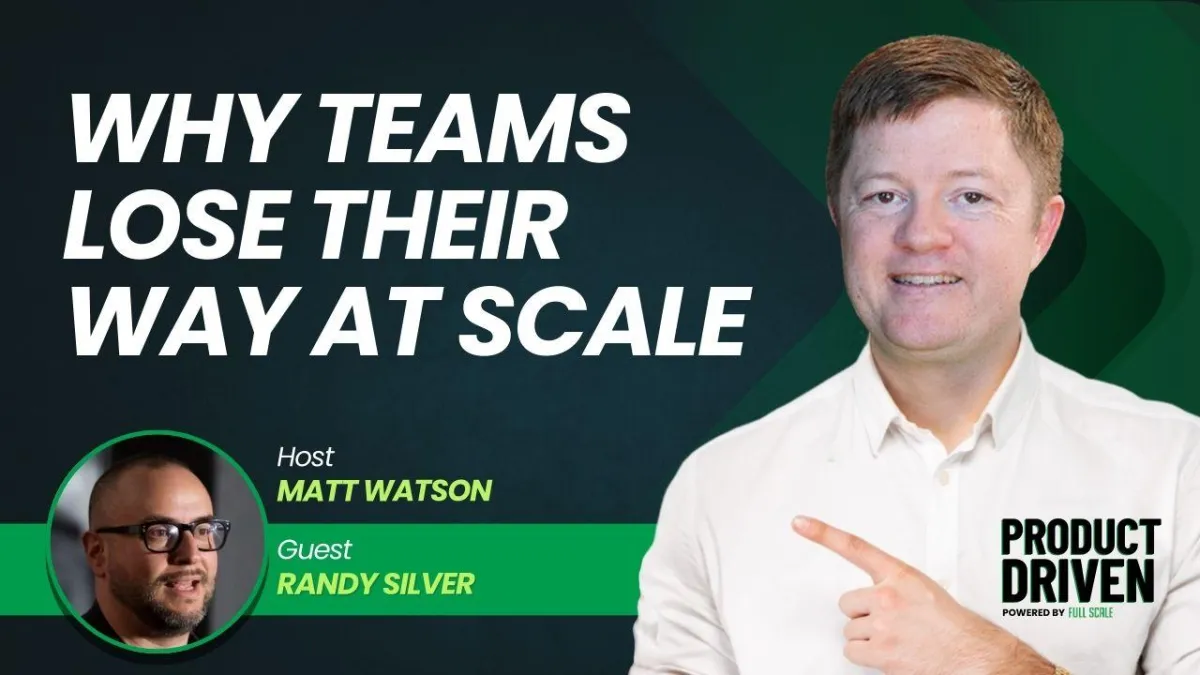
In this week’s episode of Product Driven, I sat down with product and leadership consultant Randy Silver to talk about exactly this problem.
How companies lose their way at scale—and what it really takes to lead them back.
Join 19,000+ Tech Leaders Getting Product Driven Insights in Their Inbox
© 2026 Product Driven. All rights reserved.